
Your iPhone was not made by Apple
And That Invisible Company? It’s One of India’s Fastest-Growing Sectors.
Pick up your phone right now.
Flip it over. You’ll see “Designed by Apple in California.” But nowhere on that device does it say who actually built it. Who soldered the chips. Who assembled the 2,000+ components. Who tested every unit before it left the factory.
That company is called Foxconn. And what Foxconn does - building electronics on behalf of big brands, is called Electronics Manufacturing Services, or EMS.
India has its own version of this story playing out right now. And if you’ve been watching the markets, you’ve already noticed: India’s EMS sector is growing faster than almost every other sector in the country.
Here’s everything you need to understand about why.

First, What is EMS?
Imagine you design a beautiful new smartwatch. You’ve nailed the brand, the software, the marketing. But you don’t want to spend ₹2,000 crore building a factory. So you hire a specialist company that already has the factory, the machinery, the engineers, and the supply chain. You hand them your design. They build it, test it, box it, and ship it — with your brand on the front.
That specialist company is an EMS player.
The EMS company doesn’t own the product. It doesn’t sell to consumers. It works entirely behind the scenes, as the invisible engine that turns a brand’s vision into a physical product.
“The brands get the glory. The EMS company gets the contract. And right now, India is becoming the world’s most attractive destination for those contracts.”
In India, the listed EMS companies you should know are: Dixon Technologies, Kaynes Technology, Syrma SGS, Cyient DLM, and Avalon Technologies. These are the companies building everything from smartphones and LED TVs to defence electronics, medical devices, and smart meters.
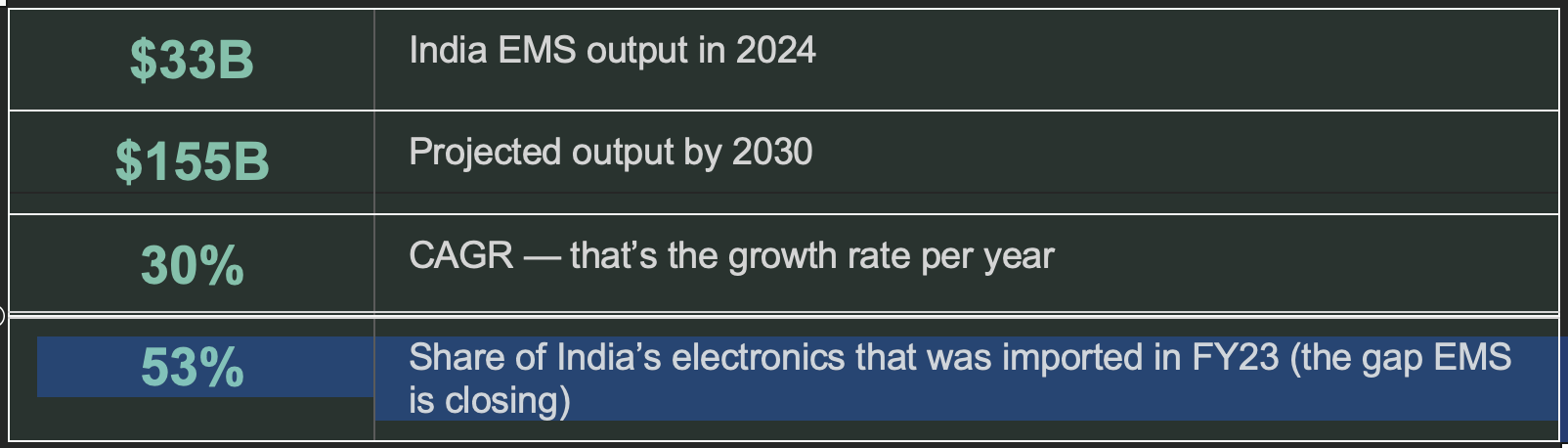
The numbers tell the story:
Why Is India’s EMS Sector Growing So Fast?
Five forces are working simultaneously. That’s the rare part.
1. The world got scared of China.
Before COVID, the world was comfortable with 46% of global electronics manufacturing concentrated in China. Then supply chains collapsed overnight in 2020. Factories shut. Ships couldn’t sail. iPhones were delayed. The world woke up to a dangerous truth: too many eggs in one basket.
Since then, every major electronics brand has been quietly executing a “China+1” strategy, building a second manufacturing base outside China. Vietnam got some of it. Mexico got some. But India, with its scale, its English-speaking engineering talent, and its government’s aggressive courtship of foreign manufacturers, is capturing an increasingly large share.
2. The government is literally paying companies to manufacture here.
The Production Linked Incentive (PLI) scheme is simple in its logic: manufacture in India, exceed your sales targets, and the government gives you 4-6% of your incremental sales as cash. No complicated paperwork. No bureaucratic maze. Just make things here, sell them, and get paid.
For a sector with thin margins, a 4–6% government top-up is enormous. It’s the difference between a marginal project and a highly attractive investment. In January 2025, an additional $3 billion PLI package was approved specifically for electronic components, bare PCBs, display modules, camera modules, passive components.
3. India is a billion-customer market and it’s just getting started.
India’s urban population hit 480 million in 2024. Its middle class is expanding rapidly. Per capita income is rising. And as incomes rise, the first things people buy are electronics: smartphones, TVs, ACs, laptops, wearables. This domestic demand alone is enough to sustain significant EMS growth, independent of exports.
Add to this: the government wants 250 million smart meters installed by 2026. Each smart meter needs a circuit board. That’s a ₹375–500 billion opportunity from a single government programme.
4. India is still massively import-dependent, which is actually an opportunity.
Here’s a number that should surprise you: India imported ₹6,200 billion worth of electronics in FY23. That was 53% of its total electronics consumption. More than half of what Indians use is made abroad and shipped in.
Every TV that India starts manufacturing locally instead of importing is revenue for an Indian EMS company. The import substitution opportunity is enormous, structural, and decades-long.
5. Apple, Samsung, and Lenovo are actually showing up.
This is the validation that separates hype from reality. Tata Electronics is already manufacturing iPhones in Tamil Nadu. Foxconn has committed to a major facility in India. Pegatron is here. Samsung is expanding. Lenovo is manufacturing servers in India for its data centre business. These are irreversible investments, not press releases.
What’s Inside an EMS Company’s Business?
Understanding the business model matters because it explains both the opportunity and the limitations.
At the core of every electronic device is something called a Printed Circuit Board Assembly (PCBA): the green board with hundreds of tiny chips soldered onto it. That’s the brain of your phone, your TV, your laptop. EMS companies specialize in making these boards and assembling them into finished products.
The typical EMS workflow looks like this:
• Receive the design from the brand (the OEM)
• Source components - chips, capacitors, resistors, displays
• Assemble and solder components onto circuit boards (PCBA)
• Integrate the board into the final product (box build)
• Test rigorously for defects
• Pack, ship, handle after-sales logistics
The more sophisticated EMS companies also do the design work itself, not just building to spec, but co-designing the product. These are called ODM (Original Design Manufacturer) capabilities, and they command significantly higher margins.
The Investment Question: Is It Worth Buying?
The growth story is real. But investing intelligently requires understanding both sides.
What makes this sector compelling:
• All five growth drivers (China+1, PLI, domestic demand, import substitution, global OEM expansion) are working simultaneously
• India’s share of global EMS is going from ~4% to a projected 7%+ - a massive jump in a $900 billion global market
• Companies like Kaynes and Dixon are diversifying into defence, medical devices, and aerospace - higher-margin, long-duration contracts
• The sector raised ₹6,800+ crore through QIPs and PE between FY23–25, showing serious institutional conviction
What you must not ignore:
• Valuations are stretched - most listed EMS stocks trade at 60–100x earnings. The market already knows this story
• Margins are thin - EMS companies typically earn 3–6% net margins. Revenue grows fast, but profit is harder to scale
• Client concentration risk - losing one large customer (Samsung, Xiaomi) can meaningfully impact revenues overnight
• Component dependency - India still imports most of the components that go into these devices. Moving up the value chain takes years
“You are not discovering a secret when you buy an EMS stock today. You are paying a premium to participate in a well-understood, consensus story. That is not wrong - but it demands patience and a long time horizon.”
The Bigger Picture
India’s EMS boom is not just a stock market story. It is a civilizational shift.
For 30 years, the world’s electronic supply chain ran through East Asia, designed in America, manufactured in China, sold everywhere. That model is cracking. Geopolitics, rising Chinese labour costs, and pandemic-era supply chain shock have forced the world to rethink.
India is positioning itself as the credible alternative at exactly the right moment. The country has the scale (1.4 billion people), the engineering talent, the improving infrastructure, and now, the government conviction to back it up.
The companies that will define this decade are not the ones assembling phones today. They are the ones moving up the value chain, building the circuit boards, then the components that go on those boards, then eventually the chips themselves. That journey from assembly to design is the real wealth-creation story.
TL;DR - If You Read Nothing Else
• EMS companies build electronics on behalf of big brands: Apple, Samsung, Dell without owning the product
• India’s EMS sector is growing at 30% CAGR, from $33B in 2024 to a projected $155B by 2030
• Five forces are driving this: China+1 strategy, PLI scheme, domestic demand, import substitution, and global OEM expansion
• The sector is real, the growth is structural, but stocks are expensive and margins are thin
• The real prize is companies moving up the value chain into components and design, that’s where the next decade of wealth creation lies
Did you personally type this all these thing
Good job with this.