
Why inflation is not a problem for Japan and China?
Most countries worry about inflation.
Japan and China don’t.
Not because they don’t print money.
Not because they don’t stimulate.
Not because they don’t want growth.
But because their economies are structured in a way where inflation struggles to survive.
To understand why, you have to stop looking at prices and start looking at behaviour.
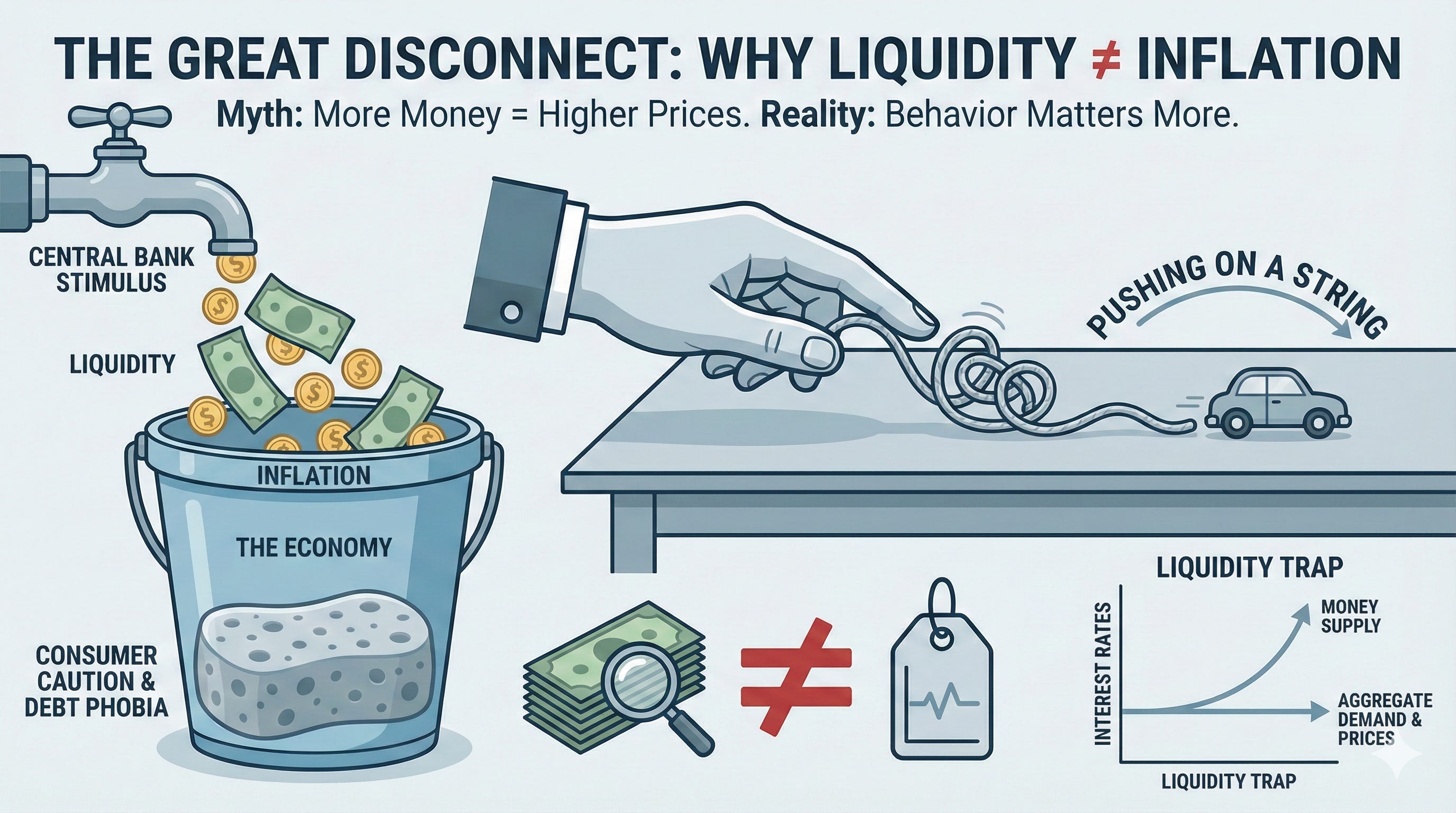
the common myth: “they just need more stimulus”
The usual explanation goes like this:
Japan has low inflation because policy wasn’t aggressive enough
China has low inflation because demand is weak temporarily
But this ignores a key fact:
Both countries have already done the things that are supposed to cause inflation.
Japan
near-zero interest rates since the late 1990s
massive quantitative easing after 2013
one of the largest central-bank balance sheets globally
China
repeated rate cuts
liquidity injections
large-scale credit creation over two decades
If inflation were simply about money supply,
both countries should have runaway prices by now.
They don’t.
inflation needs belief, not liquidity
Inflation doesn’t start when money is created.
It starts when people believe:
incomes will rise
jobs will be secure
demand will keep growing
That belief makes people:
borrow more
spend sooner
raise prices confidently
In Japan and China, that belief is missing.
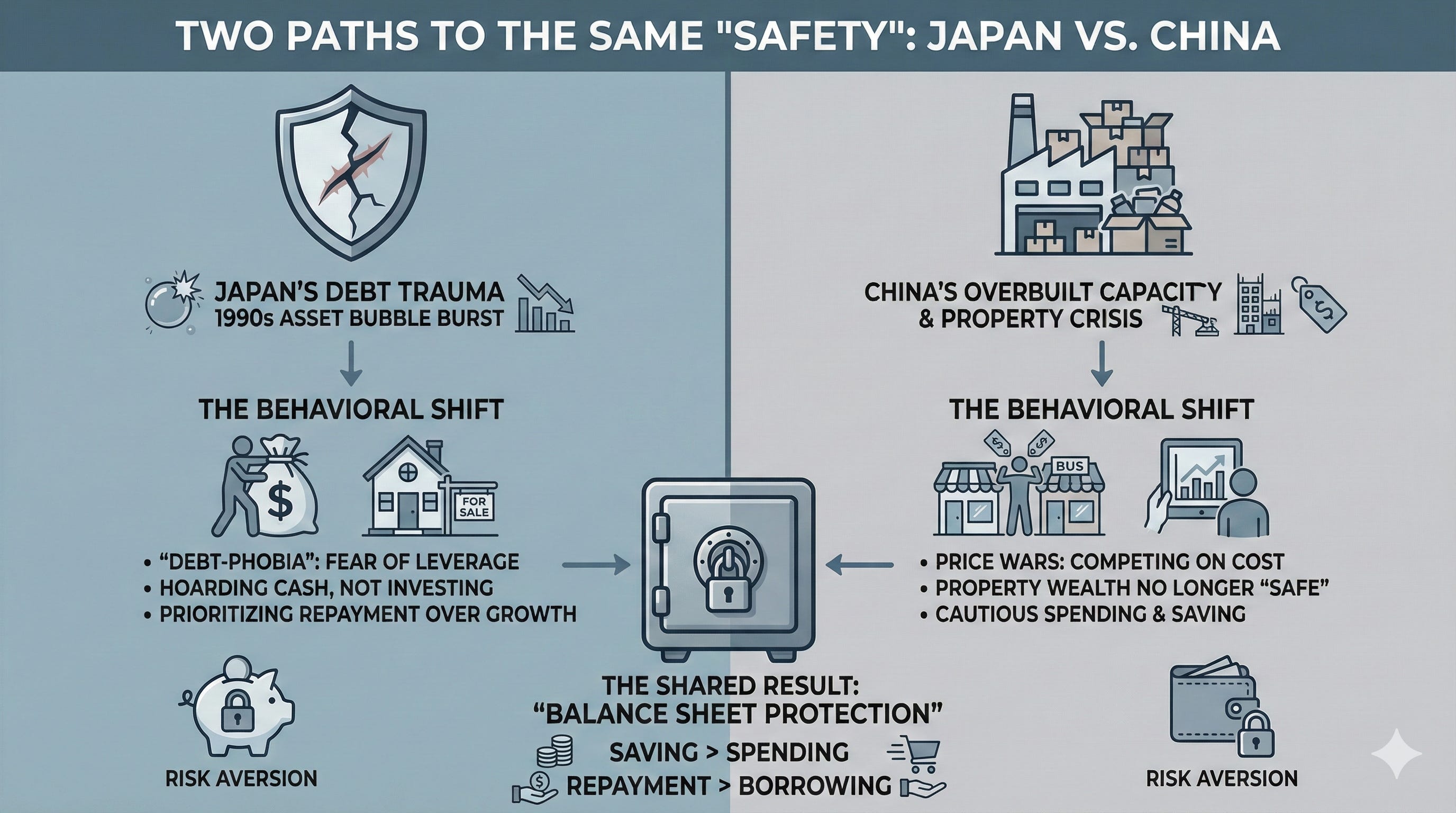
japan: the economy that learned to fear inflation
Japan’s inflation problem is actually a success problem from the past.
the 1990s trauma
late 1980s: asset bubble in stocks and real estate
early 1990s: bubble bursts
balance sheets collapse
Households, firms, and banks all learned the same lesson:
Debt can destroy you.
From that point on:
households saved more
firms avoided leverage
banks became conservative
Even decades later, that lesson stuck.
what japan does instead of inflating
When demand improves:
companies cut prices to protect market share
wages rise slowly, if at all
firms hoard cash instead of expanding capacity
Even during Abenomics (post-2013):
profits improved
stock markets rallied
liquidity surged
But behaviour didn’t flip.
Japan never returned to:
aggressive borrowing
rapid wage inflation
price-led demand cycles
So inflation never became persistent.
china: too much supply, too little pricing power
China’s story is different, but the outcome is similar.
China does not lack demand entirely.
It lacks pricing power.
china’s core issue: excess capacity
Over the last 20 years, China built:
too many factories
too much housing
too much infrastructure
This worked when:
urbanisation was fast
exports were booming
global demand was strong
But today:
population growth is slowing
property demand has peaked
global trade is fragmented
The result:
supply is abundant, demand is selective.
what happens when supply dominates
When companies compete in an overbuilt system:
prices are cut to survive
margins shrink
wages stay under pressure
This is why:
EV prices fall in China
manufacturing margins compress
exporters compete on price, not brand
You cannot get inflation when:
everyone is trying to sell
no one dares to raise prices
the property shock changed household behaviour
For Chinese households, property was:
the main store of wealth
the main source of confidence
After 2020:
developers collapsed
unfinished projects rose
property prices stagnated
That did something important:
It made households cautious.
When your biggest asset stops feeling safe:
you save more
you spend less
you delay big decisions
That behaviour is inflation-negative.
why stimulus doesn’t “stick” in both countries
Both governments can:
inject liquidity
support banks
push credit into the system
But they cannot force:
firms to invest aggressively
households to feel optimistic
wages to rise sustainably
So stimulus creates:
temporary activity
short bursts of price movement
But not a lasting inflation cycle.
Inflation fades because behaviour reverts to caution.
the shared pattern: balance sheet protection
Japan and China look different on the surface.
But underneath, they share the same behaviour.
When people feel:
scarred by past crashes
uncertain about future returns
unsure about asset values
they protect their balance sheets.
Protection mode means:
saving > spending
repayment > borrowing
competition > pricing power
Inflation cannot thrive in that environment.
why inflation is not a policy problem for them
For Japan and China:
inflation is not something to fight urgently
it’s something that rarely lasts anyway
Their bigger problems are:
weak wage growth
low confidence
falling returns on new investment
In that context, low inflation is a symptom, not a threat.
the contrast most people miss
Countries that struggle with inflation usually have:
younger populations
rising aspirations
stronger risk appetite
belief that tomorrow will be better
Japan and China currently don’t.
Which is why:
money creation doesn’t overheat
credit doesn’t explode
inflation never becomes a real problem
the one thing to remember
Inflation is not about:
how much money exists
It is about:
how people behave with that money
Japan and China don’t lack liquidity.
They lack willingness to take risk.
That’s why inflation isn’t their problem.
Top notch!
Had I told this to my teacher that inflation is not a necessity, he would have freaked out as basics of today's books are oriented towards indian economy only where controlled inflation (through central banks and government fiscal stimulus) is considered a tool for growth.
Anyways...
Considering the tighter control of government + aging population + trade surpluses also adds to this scenario along with past lessons that developed a culture of saving that let's these developed countries sustain this concept which won't be possible in still developing countries like india which is consumption oriented, has a younger population plus runs on trade deficit and also because of the shifts of newer generation towards spending that saving.
Nice write-up!
P.S.- Had to verify it since it's something that misses in general textbooks and Indian economic oriented editorials.